
I have little memory of what I read as a child. The children’s classics never much appealed to me, either then or now. My lasting memories of literature begin with what I read as a teenager. It was only when I discovered contemporary literature—contemporary, for me, being of the 1980s and 1990s—that my reading life became my own. Growing up in a fast-urbanizing Asia, I searched for books that captured aspects of that world: multi-lingual, multi-religious, fast-changing, and colorful. And how lucky I was that the time of my youth was an era of dazzlingly inventive literature that did just that.
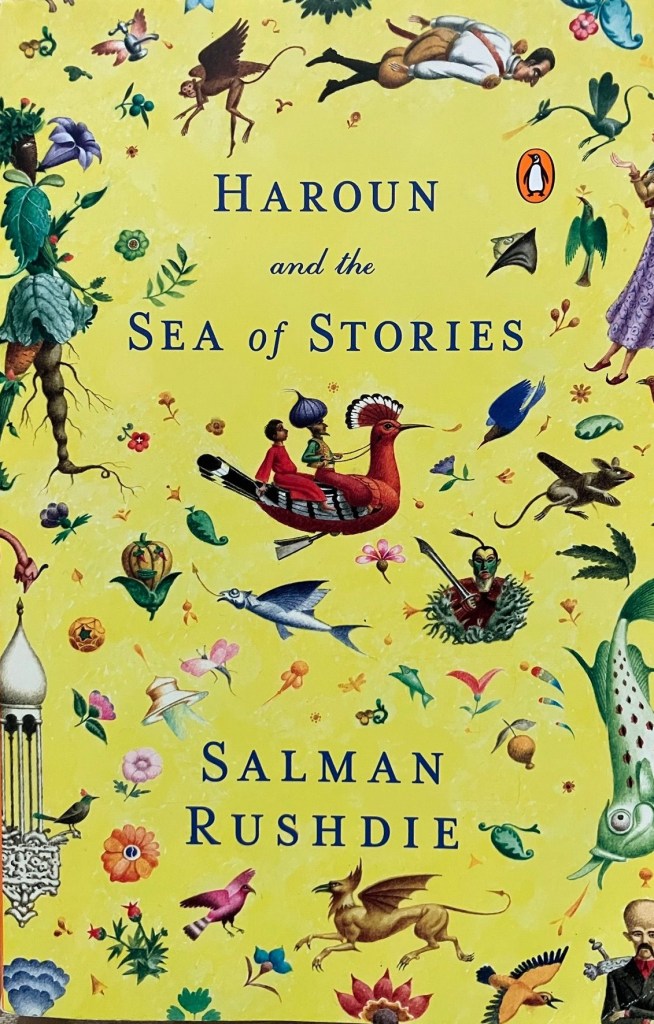
As my children approach adolescence, I have been thinking about what I most want to share with them. Recently I read them a favorite I hadn’t revisited in more than twenty-five years: Salman Rushdie’s Haroun and the Sea of Stories. I must have been around the age my son is now, twelve, when I first read it a couple of years after it was published in 1990. It appealed equally to my son and to my eight-year-old daughter, and part of the book’s appeal is that it works on many levels.
The protagonist is Haroun, son of the famous Rashid Khalifa who has mysteriously lost his gift of storytelling. Haroun sets out on a quest to restore its poisoned source in the Ocean of Story, “the biggest library in the universe.” Haroun’s adventure takes him to the heart of the silent kingdom of Chup, in a state of permanent night, to rescue the captured Princess Batcheat from Chup’s evil ruler, Khattam-Shud, “the Arch-Enemy of all stories, the Prince of Silence and the Foe of Speech.”
Rushdie’s descriptions are alive with the rhythms of India in the 1980s, which I knew as a child, complete with the beautifully calligraphed slogans painted onto the sides of buses:
ALL DANGEROUS OVERTAKERS
END UP SAFE AT UNDERTAKER’S
My daughter was almost in tears laughing at a passage that she then asked me to read again and again in increasingly outlandish voices. As Mr Butt’s Mail Coach tackles a hairy stretch of road, he shouts: “The snow line! Icy patches ahead! Crumbing road surface! Hairpin bends! Danger of avalanches! Full speed ahead!”
My children loved the inventive wordplay drawing from Hindi and Urdu, languages they don’t speak but recognize the sounds of from their love of Hindi movies. The names of the rival fictional lands, Gup and Chup, translate as gossip and silence; the name of the city of Kahani means story.
The genius of Haroun and the Sea of Stories is that it’s at once a page-turning adventure story, a profound reflection on the power of fiction, and a robust defense of the freedom of the imagination. The message is never heavy. Riotous humor takes the place of finger-wagging. But the last word goes to my daughter: “But, Daddy, why would anyone want to ban stories?”

