
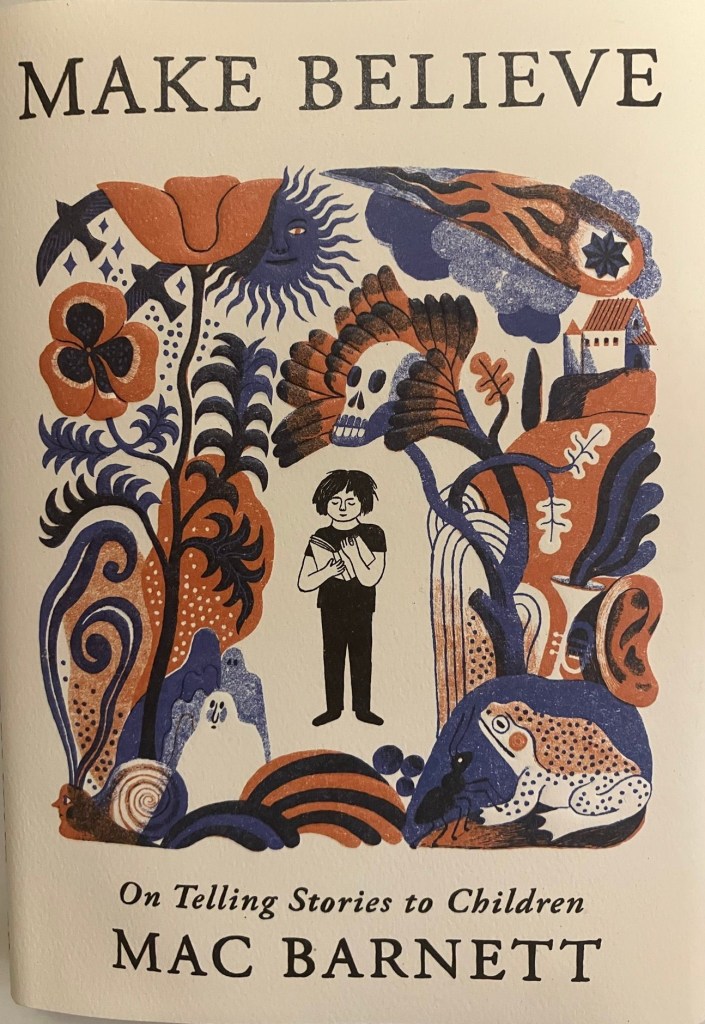
A book I have read this summer, read slowly and then re-read, has been Mac Barnett’s Make Believe. A book not for children, but for adults about children’s literature. Barnett is an author and the US equivalent of the Children’s Laureate. The core of his argument, as I understand it, has three strands. First, that the books we describe as ‘children’s literature’ are literature, they are works of art, and should be recognised, examined, studied and enjoyed as such. Second, that they should be for children, covering the full gamut of genres and styles and tastes that children will enjoy, but that they should be both for children (not what adults think children ought to have to read) and for children to enjoy – books that bring the range of reading pleasure that other literature brings to adults – but different from adults’ books, because children are different from adults. And thirdly that ‘our’, the adult world’s, lack of respect for children’s literature is a reflection of the lack of respect – not lack of love but lack of respect – that we have for children and their ability to appreciate literature. Barnett suggests that children are naturally more sensitive to art and literature than adults, their abilities not yet blunted, and so they need and deserve a rich range of literature specifically for them.
I haven’t actually read any other books by Barnett; I think he’s better known in the USA than in the UK, so I didn’t know anything about him before reading this. I know he was criticised for some passages in it, and has apologised for those as ‘hyperbolic and glib’ when he should have ‘tightened his argument’ (see Publishers’ Weekly). One section of Make Believe I particularly enjoyed was Barnett’s analysis of Goodnight Moon (1947) and his appreciation of Margaret Wise Brown. Again, I didn’t have that book as a child; I came to it as an adult and a parent, and I do love it. The early precursor to this blog was in fact a note I wrote after my husband and I read and discussed a NYT article about Goodnight Moon from 2014. I even posted an Intro to a book review series Love It/Loathe It that I never followed up, mainly because I’ve preferred not to review the books I don’t like rather single certain ones out for criticism, though I don’t disagree with my then observations.
When I was a child, my mother was always keen for me to read ‘good’ books. I don’t think I had a clear idea at the time what she meant; although I knew she wanted me to stop re-reading the Famous Five and Malory Towers, and that she would have been horrified if she had known how many Sweet Valley High books I borrowed from friends and devoured. (Often hidden under my desk during class – though I don’t think that’s the part that would have bothered her particularly.) I do remember her wanting me to read Rosemary Sutcliffe, and I did, eventually, read and enjoy the Eagle of the Ninth and some others of hers. But even as I became an adult, I don’t think my mother really understood what I loved about the books that I called for a long time my ‘guilty pleasures’, a label that I’m trying to move away from in my own head. I suppose I’m trying to understand the very many different things that I take from different books and how they speak to me in different moods, and honestly, soothe and distract me through times of stress. And if books do all those things for me, then shouldn’t they be able to do all those things for kids too?
I hope of course, that my kids don’t carry the stress that adults carry, but kids’ lives are stressful too. Kids have different interests, concerns, preoccupations. Different things strike them as humorous, scary, shocking, fascinating. But they have the same gamut of emotions as adults do, even if they’re brought on by different things, have different reactions, and less power to change their circumstances. All of which is to say that children’s books need to do a whole range of different things for a broad range of people (children) with different personalities and interests and moods.
So perhaps it’s not that 94.7% of children’s titles are crud (the assessment that Barnett published and then apologised for), but that some large proportion of books published and purchased, whilst not individually crud (though some, honestly, are – we all know it, we’ve all read some clangers), taken together, are same-y, repetitive, re-hashing whatever made some money last time. And frankly, our kids deserve better than some of the regurgitations of the same idea that they’re given. If you take a peek at the kids’ books in the average airport bookshop, an awful lot of them are by the same handful of authors. Some of which are great, and some of which are kind of stupid. And sometimes, just like us, our kids want to read a fun, stupid book, because it’s relaxing and enjoyable and takes their mind off other things. But if there are too many of those books, it reduces the space, in shops, in libraries, on our bookshelves, in our kids’ lives, for the books that will do all those other things for them. Books that reflect their lives and concerns. Books that open their imagination. Books that make them giggle. Books that make them cry. Books that keep them awake at night. As a parent, do I want all that? Instinctively, no, of course not. I just want the good, easy, bedtime-friendly parts. But I also remember all the nights, as a child and as an adult when I’ve read past my bedtime, and I recognise that some of that is necessary experimentation, and part of exploring being human – through books and through our relationships with them that are somehow part of our relationships with ourselves.
So, no, I don’t let my kids sit up late into the night reading. And I do encourage them to try new authors, and stretch themselves and I don’t buy or borrow books that I personally think are stupid, and I try to avoid the ones I think are badly written. But I’m trying very hard not to judge. Or not to judge too much. And sometimes the kids surprise me, critiquing the books they’re reading in ways that are more sophisticated than I expect. I think kids are natural critics; they don’t assume everything is good or right because an adult says it. And they don’t assume a book is good just because someone chose to read it to them. My daughter, aged 8, was not impressed with the dialogue in Alice in Wonderland, so much so that I ended up finishing the book just with her brother. She also described one book she had stopped reading as ‘ponderous’, and on reflection, I can see her point.
Overall, Barnett’s book has led me to reflect again on why I read, why I encourage my children to read, why I read with and to them. Why I always want to talk about books. Why they matter so much. Such reflections are in many ways why I started to write this blog, because I was excited about stories and wanted to share that excitement, with my children and with other people and their children. Because reading – and writing – are fun. So, I have thought and continue to think a lot both of and about children’s books, about books in general, about the peculiar alchemy that occurs when the right book and the right person meet at the right moment. And how exhilarating it is to try to help bring about those joyous moments of serendipity.

