
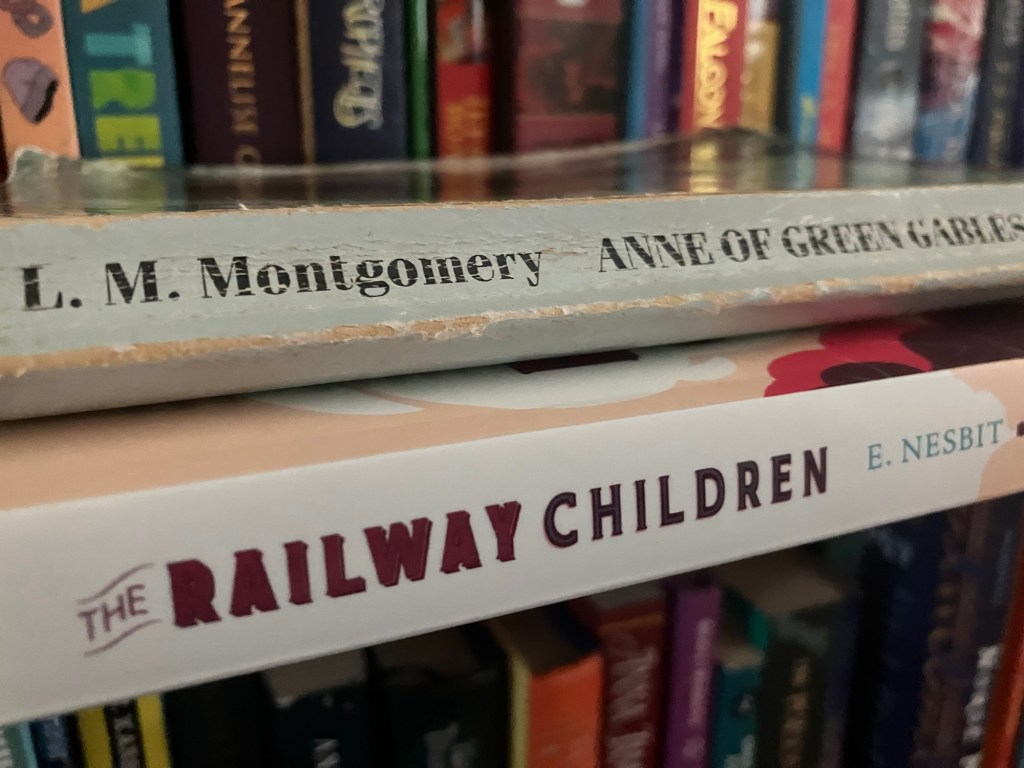
As I explained in an earlier post, I have been reading some classic children’s literature to my two children, now aged 8 and 12 years. They can, of course, and both do read independently, but there’s a particular joy in reading aloud and being read to. Some stories were designed to be enjoyed that way – think of Dickens and others serialising their books, writing a chapter for each issue. But deeper than that, sharing stories is such a long-held human pleasure.
When I read aloud, we experience the book and meet the characters together. The kids exclaim at what’s going on and make predictions. They voice their suspicions about a character, and then their vindication when they’re proved right. The books we read become part of their joint experience and memory, a bank of shared stories that builds an imaginative bridge between them. A bridge that includes me. I love reading aloud; re-visiting these stories, or encountering them for the first time. Sharing characters I loved and meeting new ones. The excitement of piling into one bedroom together to get the next instalment. For me, reading can be a joy of solitude, but also a joy when shared.
We encounter lots of new vocabulary, but also new concepts, different ways of living. In older stories, sometimes the families have someone working for them, and I try to explain the social strata between rich and poor, those who go into service and those who have ‘help’. A different set of preoccupations and concerns. The means of travel, the clothing, the etiquette, the strange combination of restrictions and independence that children in the past seemed to experience.
It’s also an introduction to an older style of writing. So often the sentence length and structure is different from contemporary writing, and it can take a few pages to get the rhythm and sense, the voice. I experience it myself when I’ve been reading newly published books, and then go back. So I hope that reading aloud helps them to calibrate to a different style of writing that will make other, older books, more accessible in the future.
So here are a few of the older books that we’ve enjoyed, all written well over a hundred years ago:
The Railway Children by E. Nesbit, first published 1906
There are plenty of older ideas and conventions in here – coal-fired trains, girls wearing flannel petticoats, halfpenny buns for tea. The siblings, however, Bobbie, Peter and Phyllis, squabble in a thoroughly recognisable way, and there’s lots about helping people without expecting anything in return. The most exciting part though is the train, which some of you may remember from the 1970 film with Jenny Agutter as Bobbie. It was rather thrilling to watch my kids grasp each others’ hands, bracing for the outcome, whether the train could stop in time or not.
Anne of Green Gables by L.M. Montgomery, first published 1908
I adore Anne (though I may love Emily of New Moon even more). Reading this aloud was a complete joy, and also an exercise in breath control. Anne talks *a lot*. Sometimes there is more than a page without even a paragraph break as she explains something to Marilla. And of course, to make it sound like Anne, or how I imagine Anne sounding, it needs to be expressive, which makes it joyful but exhausting! But Anne sticks in their heads – just last night we had a ‘family quiz’ over dinner, taking turns to ask each other questions based on Anne of Green Gables and even though it’s several months since we read the book, all the details came flooding back. I think I will be reading Anne of Avonlea to them soon – Anne is too much of a joy not to read just one more …
Little Women by L.M. Alcott, first published 1868
I think this is the oldest book we’ve read together, though the opening dialogue reads as though it were written much more recently, the sisters are so real. We enjoyed their different characters, and their arguments and reconciliations, and picking which was our favourite (Jo, of course!). I had perhaps forgotten the religious thread running through this book, Marmee giving them Bibles, and Amy’s shrine. I’ve also read, fairly recently, Geraldine Brooks’ wonderful book March (2005), about Father and Marmee as people, not just parents, so I had that in my mind too as I read. We live in Connecticut now, but we used to live in Massachusetts, and although the kids were probably too little to remember it, we did visit the Alcott house in Concord where Louisa May lived with her sisters, so it was nice too to make that connection.
P.S. What I’m reading. I have been travelling recently, and had lots of time to read, so I finally opened up Barry Unsworth’s Sacred Hunger (1992) on my Kindle, having loved his medieval-set Morality Play (1995) some while ago. The subject matter (the trans-Atlantic trade in enslaved people) is difficult, but it’s incredibly well-written, and I read it much more quickly than I expected to. It’s a heavy book, in size and emotions, but very human.
I then savoured every one of the 100 pages in Emily Tesh’s folklore derived Silver in the Wood (2019). I think I’m going to like Emily Tesh’s work; I have her sci-fi novel Some Desperate Glory (2023) on my shelf.
From there, straight into my husband’s recommendation, Loot by Tania James (2023) – we visited Mysore many years ago and now I want to take the children. And finally, Unsheltered by Barbara Kingsolver (2018), whose work I always admire.
Now I need to pick what’s next!

