
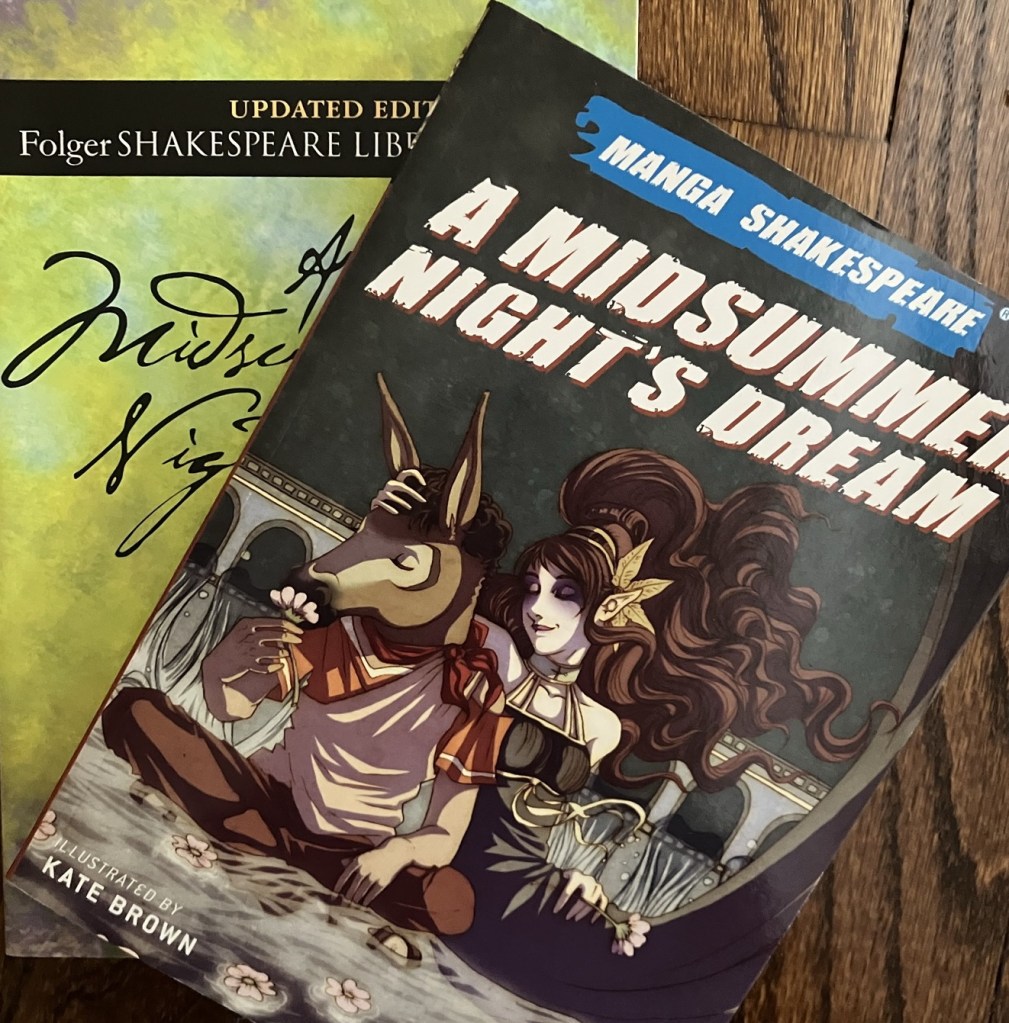
As I said in my previous post about kids and Shakespeare, the first real play I took my son to was A Midsummer Night’s Dream at Shakespeare’s Globe in London in the summer of 2023 when he was 9½. So here’s the story, and some further thoughts on how I’ve been trying to introduce my kids to the Bard.
I love Shakespeare’s Globe (a replica, close to but not on the site of the original Globe Theatre), and, as always, found the setting added to the experience. We attended a matinee with a dear friend of mine and her nearly-teenaged son. My friend was using a wheelchair so I’d booked a wheelchair space in the ‘Gentlemen’s Gallery’ which gave us an excellent view. The staff were immensely helpful, escorting us in. We reached the gallery by lift, going slightly behind the scenes, getting a sneak peek preview and a look at parts that aren’t usually open to the public, props piled high, pieces of set, which added to the anticipation. (And on the way out, a glimpse of and a wave from some of the cast, still in costume.)
A Midsummer Night’s Dream feels like a good place to start with Shakespeare. It’s so lively and confused that I’ve found the children really enjoying the arguments and absurdities, as well as the magical setting. To familiarise him with the story, and so he could start to enjoy the language, I’d bought my son the Manga Shakespeare version (illus. by Kate Brown). He’s also a keen artist and enjoys the manga style of art; these books are graphic versions of the play with manga art illustrations, but using Shakespeare’s original language adapted by Richard Appignanesi. The story is vivid and fast-moving, but the poetry is retained. We have a few in the series and have found them an excellent introduction: https://www.mangashakespeare.com/. Other good, accessible graphic series are Classics in Graphics or No Fear Shakespeare Illustrated, and there are others, but I prefer the Manga Shakespeare because they’re an abridged version of the text, rather than just another re-telling of the story. So they introduce the language, the rhythm, the poetry, as well as the story and characters.
Most of Shakespeare’s plays have an edge, even the comedies, and MSND is no exception. Every play throws up knotty conversations and things that need time to be explained and discussed. The production we saw was generally good-humoured, not pressing deeply into those more difficult aspects. However, the actor playing Hermia, the wonderful Francesca Mills – I missed her Duchess in the Duchess of Malfi in 2024, curses – has achondroplasia; the ableist taunts thrown at Hermia landed with extra force, the audience audibly gasping. Amongst our group in the Gentlemen’s Gallery, the sting was sharply felt, and although the play moved on, the confrontation reverberated for us, and led to lots of conversation and discussion and questions after the play ended.
All of which I feel a good play should lead to. Books, and the theatre, are a space to explore emotions, conflicts, hope and fear, the things that we share as humans. The communal experience of a play, acted in your presence by other people, takes you through those highs and lows; many Shakespeare plays end with a song and a dance on purpose, a cathartic release – and a reassurance to the children, and the rest of us, that everyone is ok, no one has been hurt. Actors playing enemies and friends come together at the end, taking their bow together. For me, the theatre is magical, transporting, and Shakespeare’s plays are endlessly open to interpretation and re-discovery. Little wonder it’s something I’ve longed to share with my children as they become old enough to experience it for themselves.
P.S. What I’m reading. I need to speed up, but I am mostly enjoying, with one or two skeptical notes, Susie Boyt’s Loved and Missed (New York Review Books, 2021) which is this month’s pick for my book club. I always find it slightly disconcerting when a main character has the same name as someone I’m close to, so sharing a first name with the narrator is occasionally distracting, but fortunately it’s in the 1st person so the name isn’t used all that frequently. And I’ve got a couple of writing craft books waiting for me; Elizabeth McCracken’s A Long Game: Notes on Writing Fiction and Lily Dunn’s Into Being: the radical craft of memoir and its power to transform. I’m a big fan of London Lit Lab, founded and run by Lily Dunn and Zoe Gilbert and have been fortunate enough to take online classes with both of them, so I’m looking forward to learning more from Lily’s book.
 Books for Our Children