
Yes, I know this blog is all about books for children, but for today’s post (and this mini-series – however long it ends up being) it’s about literature for children, and we’re expanding out to consider the theatre. I love the theatre. Almost any theatre. Big shows, small shows, fancy productions, school productions, serious, funny, tragic, modern, ancient, I love it. I’m prepared to be much more experimental with the theatre than I am with e.g. the cinema, or live music, but I have a particular passion for Shakespeare.
My mother shared her love of theatre and of Shakespeare in particular with me and my sister from a young age. I don’t know how old I was when I first saw a Shakespeare play on stage, but I remember counting up once that I had seen Julius Caesar – my mother’s favourite – on stage four times by the age of 12. I grew up not far from Manchester in the UK, and we had a richness of culture available; amateur productions at Wilmslow Leisure Centre; plays at the Wythenshaw Forum with its distinctive flooring, like grooves on a record; the theatres in central Manchester, the Palace, the Opera House, the Royal Exchange, the Contact, the Library theatre; plays out at Buxton Opera House (I recall Help! Help! The Globolinks!), and later at the Lowry in Salford.
The RSC used to bring their shows on tour, and set up a theatre in the round in the gym at Macclesfield Leisure Centre. I remember seeing Julius Caesar (of course) there, in which Caesar was portrayed as a Soviet-era president and the audience with walking tickets (including us) were part of the crowd being held back by the security guards in their black suits and dark glasses.
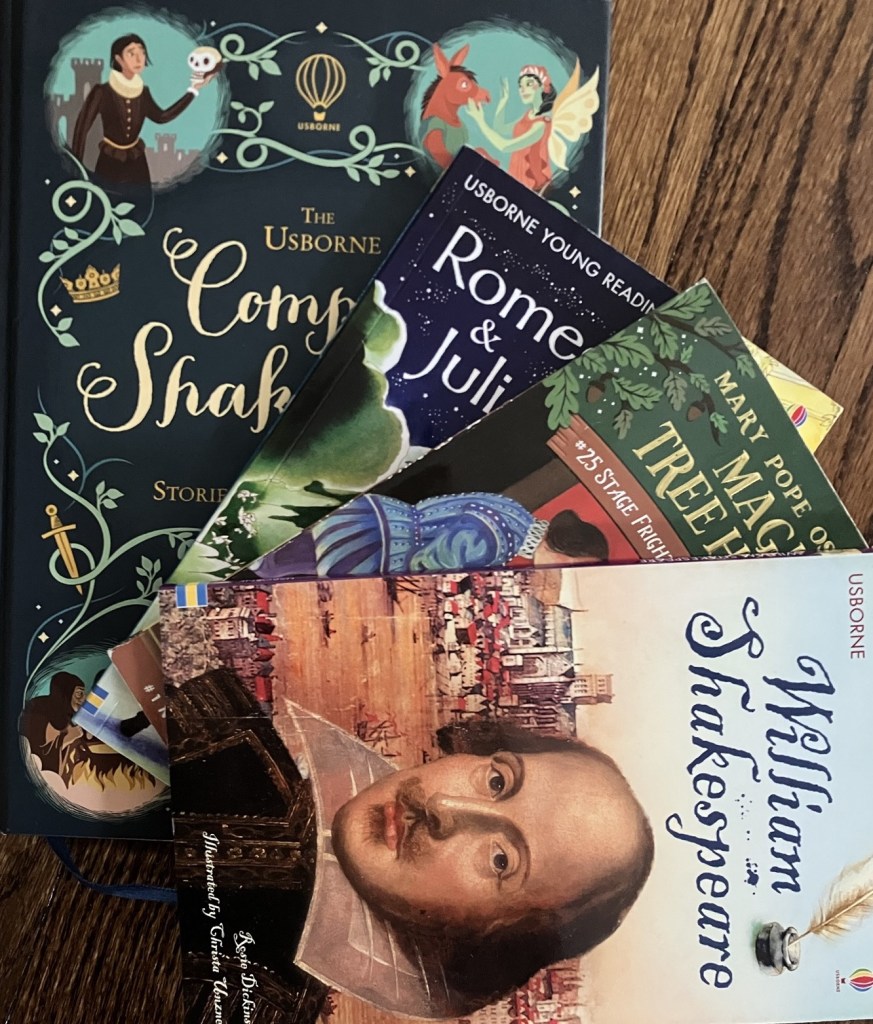
Which is all a prelude to talking about introducing my own children to the theatre and to Shakespeare. I started with the stories. I had read Lamb’s Tales from Shakespeare; we started with The Usborne Complete Shakespeare: Stories from All the Plays (illus. by Maria Surducan). Some of the stories were also part of the Usborne Young Reading – Romeo and Juliet is included in Series 2 and Othello and a non-fiction about William Shakespeare himself (by Rosie Dickins) in Series 3. There is also a Magic Tree House book, #25 Stage Fright On a Summer Night (by Mary Pope Osborne, illus.by Sal Murdocca, 2002) in which Jack and Annie meet Will Shakespeare and perform at the original Globe theatre as fairies in A Midsummer Night’s Dream.
I have a particular love of Shakespeare’s Globe in London. I went as often as I could when we lived in London, usually standing in the Yard, and saw many memorable productions. (One stands out in particular, part of the 2012 Globe to Globe Festival, in which every play was performed in a different language; we saw Richard III (one of my favourites) performed in Mandarin with surtitles, and it was the most electrifying Richard I’d ever seen.) So I started the children at the Globe, which has recently had productions inspired by a Shakespeare play, designed for children aged 5-12 years old, performed in the indoor Sam Wanamaker Playhouse. So in 2023 we all saw Midsummer Mechanicals, featuring the characters from a Midsummer Night’s Dream, and I also took my son to see MSND itself in the main Globe.
Midsummer Mechanicals, and the play that followed in 2024 and 2025, Rough Magic (inspired by the witches in Macbeth) have been joyous, interactive, hilarious delights, that kept even the littlest ones thoroughly engaged. The performers were spectacular, riffing off the audience response, drawing the children into the world of the play with every turn. I’m excited to see what the Globe has for children next year. Before that, particularly with the pandemic, they’d seen almost no live theatre, and it was a pleasure and relief to be able to take them. A feeling that I was finally able to share something that mattered so much to me, and which had brought me so much joy over the years, starting to pass down what my mother had gifted to me.
P.S. What I’m reading. Mainly for work, but also for curiosity, today I have been reading Tyler and Trinkner’s Why Children Follow Rules: legal socialization and the development of legitimacy (OUP, 2017), which has got my mind churning; it discusses parenting styles, school discipline and youth criminal justice, and touches on so many areas of interest and concern. (Though the parent in me is also wondering if there should be a companion volume on Why Children Don’t….)
On a lighter note, I have started the first in Autumn Woods’ Sorrowsong University duology Night Shade, which bills itself as dark academia, but gothic rather than fantasy. Hopefully it will be fun. I do enjoy dark academia as a genre, but tend to fantasy within in. I enjoyed R.F.Kuang’s Babel, and have her Katabasis on my TBR shelf. I very much recommend Leigh Bardugo’s Yale-set duology Ninth House and Hellbent. Hellbent is a title that continually delights me with its equally applicable dual meanings, and the books are even more fun if you know New Haven at all. However, within dark academia, my heart truly lies with Naomi Novik’s Scholomance trilogy (A Deadly Education, The Last Graduate, The Golden Enclaves) which I re-read periodically when in need. It satisfies the yearning for a good story, well-told; a message that feels relevant outside the confines of its own world-building; and a truly outstanding heroine.


The Scholomance trilogy is very much a continual comfort re-read for me too! Such a fun and satisfying read 🙂
LikeLiked by 1 person