
My son has had a fascination with ancient civilizations and with Ancient Egypt in particular for many years now. As well as reading the myths, he’s spent time learning hieroglyphs, can name and discuss many pharaohs, and enjoys few things more than sketching statutes and mummies in museums. (I have also iced hieroglyphs onto at least two of his birthday cakes, and we had one party at which I had to insist that he wrote his friends’ names on the party bags in English letters as well.) Unsurprisingly, we built a small collection of books about Ancient Egypt when he was younger. As he’s got older and his interest has continued, we’ve been on the lookout for books with more content, but still accessible to a 12-year-old.
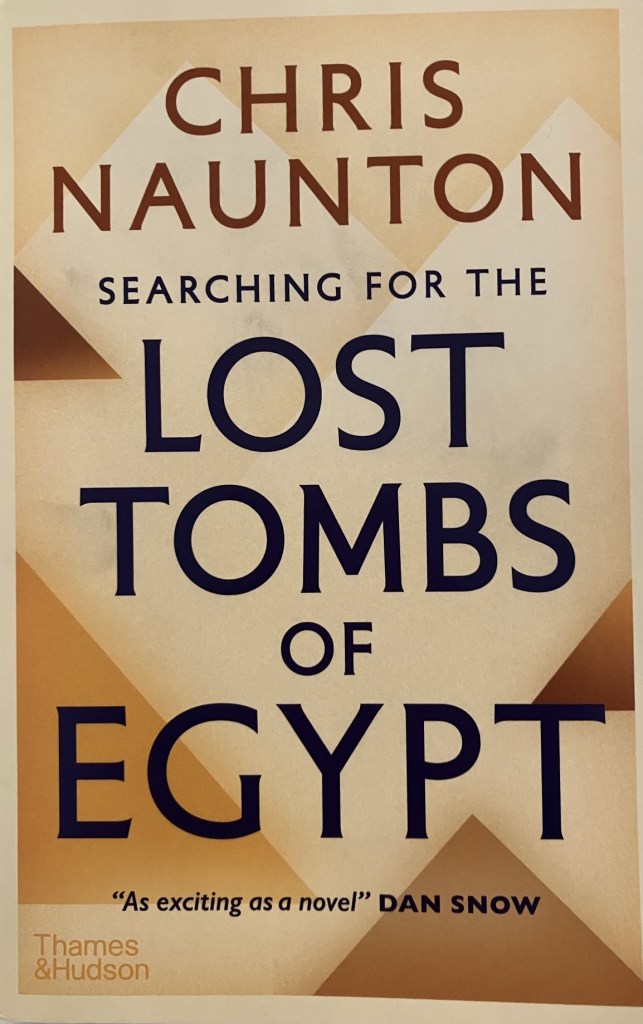
Our latest discovery, which we bought after visiting the Divine Egypt exhibition at the Met in New York (now sadly closed) is Chris Naunton’s Searching for the Lost Tombs of Egypt (London, 2018). My son has just finished it, and I get to read it next. We’d heard of Chris Naunton, as he was one of the experts featured in National Geographic’s Lost Treasures of Egypt series, which we have enjoyed. I think it’s probably a stretch to describe him as a celebrity author, but there was certainly some name recognition involved. However, what Chris Naunton does so well, both on TV and in his book, is make the archaeology accessible to non-experts, so this was an excellent next step. My son particularly liked the mysteries around Akhenaten, Smenkhkare, and their family, at a time of religious revolution in Egypt.
If you’re interested in the books we’ve enjoyed along the way, here’s a selection of favourites that have fed his interest in the past (with thanks to my son for the recommendations and comments):
Myths
Myth Atlas: Maps and Monsters, Heroes and Gods from Twelve Mythological Worlds by Thiago de Moraes. I reviewed this a while back, see here. This is fun for younger school age kids but with great illustrations it has been read for many years now.
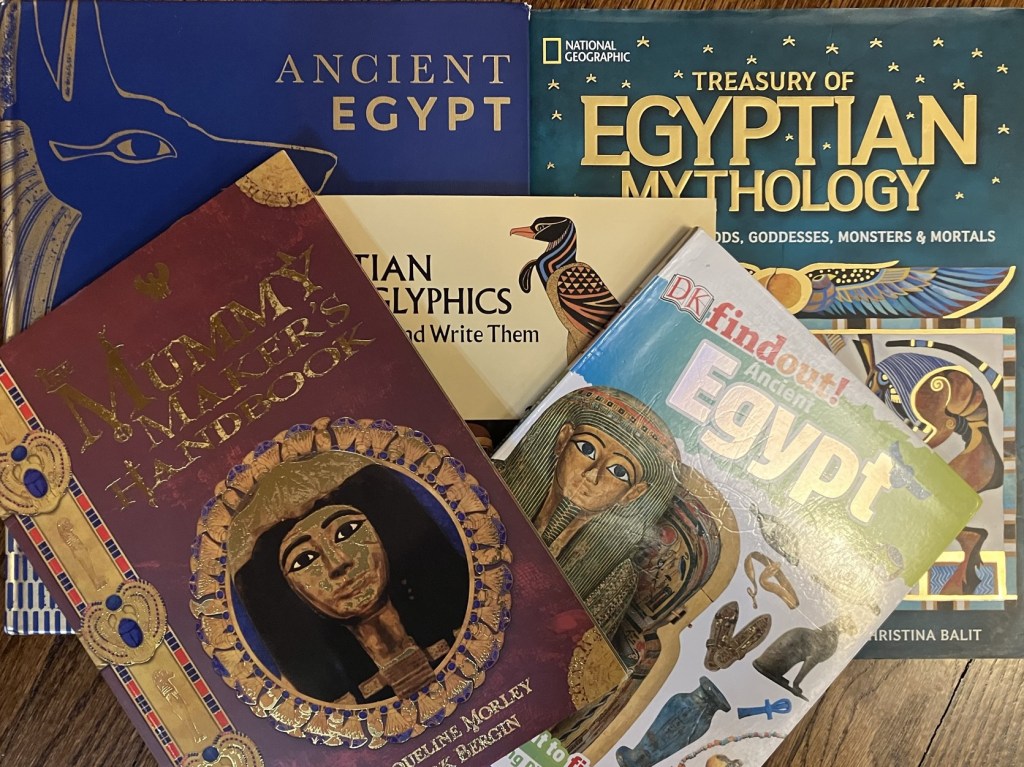
Two of the best myth books, both with gorgeous illustrations, both including information about the gods and their symbols. At a guess, these would perhaps be fun from age 8-9 years.:
Egyptian Myths: Meet the Gods, Goddesses, and Pharaohs of Ancient Egypt, written by Jean Menzies, illus by Katie Ponder, DK, 2022
Treasury of Egyptian Mythology: Classic Stories of Gods, Goddesses, Monsters & Mortals by Donna Jo Napoli, illus by Christina Balit (National Geographic, 2013)
Ancient Egyptian life/archaeology
A great place to start: DK FindOut! Ancient Egypt, Dr Angela McDonald, 2017.
The next step: DK Eyewitness Ancient Egypt, George Hart, 2014
The Mummy Maker’s Handbook by Jacqueline Morley and Mark Bergin (Scribo, 2016) and How to be an Egyptian Princess, by Jacqueline Morley, illus by Nicholas Hewetson (National Geographic, 2008) Nicely illustrated slim paperbacks, estimated 8-9 years.
Not just Egypt, but lots of interesting stuff for budding archaeologists: Secrets of the Dead: Mummies and Other Human Remains from Around the World by Matt Ralphs and Gordy Wright, The British Museum (Nosy Crow, 2022)
The Golden King: The World of Tutankhamun by Zahi Hawass (Secretary General of the Supreme Council of Antiquities in Cairo), National Geographic, 2004. Slightly older, around 11-12 years.
The G.O.A.T (apparently): including the chronology of dynasties, Egyptian lifestyle and kings: Ancient Egypt: The Definitive Visual History, by Steven Snape (DK, 2021) (This book is visually stunning, but also very heavy. You would not want to drop it on your toe.) Suitable for older readers and adults – devoured, Ammit-style, by the dedicated.
Hieroglyphs
Start here: The Metropolitan Museum of Art, Fun with Hieroglyphs by Catharine Roehrig (Simon & Schuster, 2008)
Then: Egyptian Hieroglyphs: How to read and write them by Stéphane Rossini (Dover Publ, 1989) This is quite dense so it is still a work in progress with plenty to learn!
Fiction
Many will know Rick Riordan’s the Kane Chronicles, starting with The Red Pyramid (2010), but we enjoyed the Knife of Osiris, the Curse of King Tut book 1 by P.J.Hoover, (Roots in Myth, Austin, TX, 2020). My son and I read this together a few years ago, taking turns reading a page or so aloud to each other. Our favourite character was the chief shabti, Colonel Cody. ( I had to read ahead to check if he survived or not. We cared about Colonel Cody.)
P.S. What I’m reading. I was able to spend some time over Spring Break with my mother, and we’ve been reading Emma Smith’s This is Shakespeare: How to Read the World’s Greatest Playwright (Penguin, 2019). My mother has always been a Shakespeare fan and I owe my familiarity with and love of Shakespeare to her; but I’m pausing this now and will go back to it when we’re together again. I’m now reading, partly for work, partly for understanding (and very non-child suitable) Murderland: Crime and Bloodlust in the Time of Serial Killers by Caroline Fraser (Penguin, 2025). I don’t read/watch/listen to true crime, so this is unusual for me. It’s told in the present tense, weaving together the history of smelting and heavy metals in the Pacific Northwest – the lead and arsenic filling the air and ground and water – and accounts of a number of serial killers operating in the area in the 1970s, and the author’s own personal history, growing up there at that time. It is disturbing, but it’s meticulously researched and written starkly, without embellishment. For someone with a professional interest in crime and in the environment, it is compelling and important reading.
 Books for Our Children