
Fortunately, the days are gone when we needed Teeth Are Not For Biting (by Elizabeth Verdick, illus. by Marieka Heinlen, Free Spirit, 2003) and No More Biting for Billy Goat! (by Bernette Ford and Sam Williams, Boxer Books, 2013) – the two books that got us through a rough patch that I’m sure the parents of many toddlers will identify with. However, there are still plenty of occasions when a book says it better than Mummy or Daddy can. Whether it’s the slight de-personalisation, the feeling that you’re not the only one to go through it, or the reassurance from someone who’s not a parent, hearing it from a book via a character seems to make all sorts of lessons more palatable and more digestible. (Which reminds me of one of my personal malapropisms from many decades ago, explaining to a tutor that I was internally digesting the message of a lecture – I think I meant inwardly…)
Many of the books I have reviewed have messages that I hope my children are absorbing. Victoria Shaskan made this point better than I could in her review on this blog – All the World: what I’m desperate for my children to know (see also her review of Who Do I See in the Mirror?)
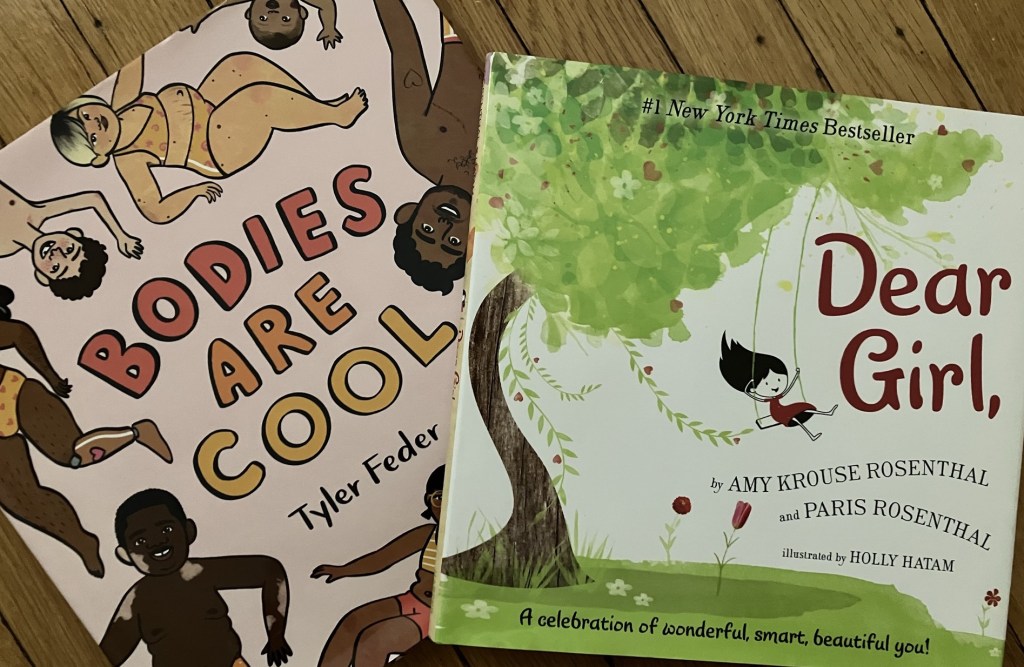
Beyond that, my instinct in parenting – as in so much of life – is if there’s a problem, find a book on it. A book will help you. I’m clearly not the only one. I confided in a friend when my daughter came home having been teased at school. What could I say? How should I reassure her? Within the week, we’d been lent Bodies are Cool (by Tyler Feder, publ. Dial Books, Penguin, 2021) and one other. If a book can get us talking and thinking and sometimes laughing about a trial or an obstacle, it’s already helping.
If we’ve had a more challenging day, I sometimes bring out Dear Girl (by Amy Krouse Rosenthal and Paris Rosenthal, illus. by Holly Hatam, publ. Harper, 2017) as a reminder to us both. And sometimes I manage to read the last two pages without the lump in my throat becoming too obvious: with all the books and reading, what I’m trying to impress on her is that ‘you can always always always …turn to me.’
P.S. What I’m reading or in other book news… After Wuthering Heights, I decided on a genre-shift, so I’m now reading a new non-fiction book, Art Cure: The Science of How the Arts Save Lives by Daisy Fancourt (Celadon, 2026) who is a professor at UCL. I am typically rather impatient with popular science books; once I’ve got the idea, I’ve got it and I don’t like being told it over and over again. This book is not annoying, it is fascinating, and makes me wonder why people aren’t doing these things all the time in schools and hospitals and nursing homes etc everywhere.
My interest in Wuthering Heights has also got me listening to some book podcasts, which is very uncharacteristic. I have been enjoying the Book Review from NYT (reviews of Pride and Prejudice, Demon Copperhead and Bridgerton!), and also a London-based podcast called Always Take Notes, currently interviewing Mary Beard on the dialogue between popular culture and the ancient world.
I have given book journals as gifts to my own kids and to a friend’s son recently. I do hope they enjoy them, and that the process of writing in the journals helps them develop a closer relationship with the books they read. I’ve kept a book journal on and off, never consistently. My primary school sometimes made me keep a reading record and maybe it irked me at the time, though I think I enjoyed it even then. Now I’m always glad to find those records and journals again and see what I read when and what I loved. It’s making me want to start a book journal again, and also to do a much needed audit and Spring clean of my Kindle and bookshelves. Which series are worth completing, which aren’t, which books need to be read again, which to donate and hope someone else enjoys!
 Books for Our Children