
My son, now 12 and a middle grader, agrees that he likes to read but is not a bookworm. He likes to read, he likes to be read to, and he likes to read together, but it’s rare for reading to be his first activity of choice (he’d usually prefer to draw). Note my surprise and a certain amount of delight when I’ve found him reading unprompted, and vocally recommending this book to us.
My suspicion is that because he often doesn’t read as a first choice, he doesn’t build up the momentum with his book – if you keep stopping and re-starting, and not getting far before the next gap, it takes longer to ‘get into’ the book, and it doesn’t get time to work its magic. We’ve all had the experience of setting a book down part way through, and then too much time passes, and when you get back to it, the characters are unfamiliar again, and the whole thing is a bit lifeless. So, without wanting to make reading a chore – always emphasising reading as a pleasure – I have been encouraging a more regular habit. There are so many good things that come from reading, the evidence keeps on mounting. Most importantly, it’s fun!
He’s told me that he doesn’t have a particular taste in books, he likes everything. I suspect that he does have his own tastes, but, perhaps like me, his taste is a bit eclectic and hard to pin down, so it is tricky to find a book I can be sure he will like. I hope that as he explores, he grows in confidence in finding books that appeal to him. As he does, we’ll try to feature here some of the books that do enthuse one particular non-bookworm middle grade reader.
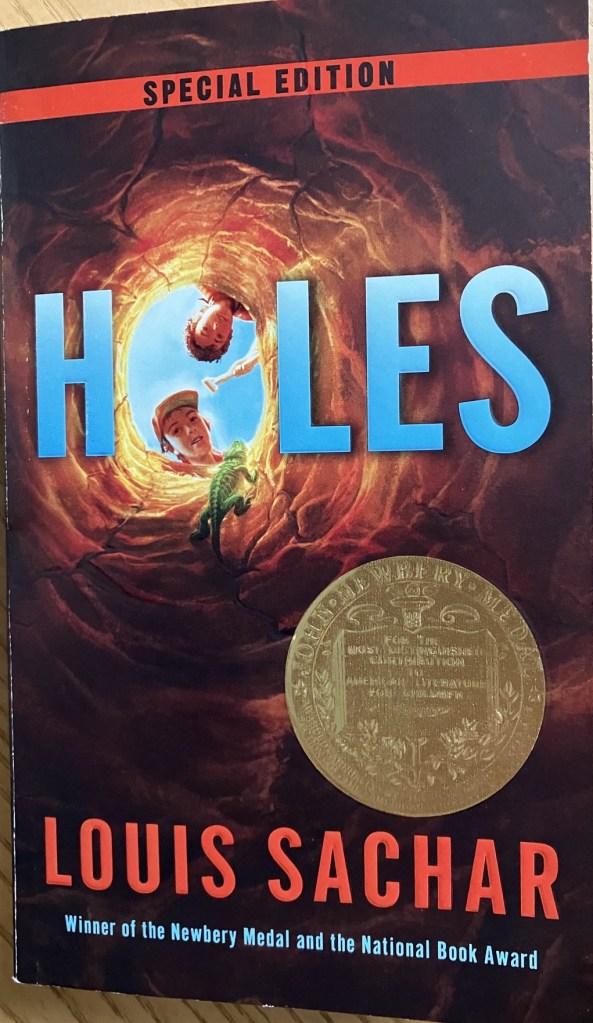
So what’s so great about Holes? I think I bought it for him; first published in 1998, it won a lot of awards including the Newbery Medal and the National Book Award. I asked my son to give us an outline of the book, so here’s what he says (with some spoilers):
‘It’s the story of a boy named Stanley Yelnats (yes, his name is the same backwards). There is a curse on his family, all because of his “no-good-dirty-rotten-pig-stealing-great-great-grandfather.” He is unjustly sent to a correctional camp named Camp Green Lake. There is no lake, just the dried-up place where the lake used to be. All the boys do is dig holes, five feet wide, five feet deep. But why are they digging the holes? And could a strong friendship break the curse on Stanley’s family? Read to find out!’
We’ve been trying together to pin down what really worked for him about this book. It’s pretty gritty, and we agreed it’s a book that ‘could happen’. His favourite moment is towards the end when (spoiler alerts!) the mean camp director, The Warden, who’s been abusing the boys gets served with a court order by Stanley’s lawyer and Stanley is finally released from the camp. I wondered whether this appealed by satisfying his sense of justice. Or perhaps it was the real life setting and the big themes that caught his attention. It’s a story about the boys at the camp, and the unjust way they’re treated, and the friendships that develop. But on the way, the back story comes out, a love-story between a white woman and a Black man in Texas over 100 years earlier, its tragic end and the revenge that follows. There are a lot of ideas and emotions packed into a relatively short book. Maybe it’s good writing and believable characters that make a book work and Louis Sachar certainly delivered with Holes. So much so that I’m getting hold of Sachar’s Small Steps for my son, featuring some of the other boys from Camp Green Lake, Armpit and X-Ray.
I remain vigilant for books my son might enjoy: I mentioned in a previous post – in the ‘P.S. What I’m reading’, if you got that far – that I had tried my hand at the NYC Midnight Short Story Challenge. It was a challenge, particularly as the genre I was assigned to was ‘thriller’ and we only had 2k words. So I did my best, and the final story wasn’t completely PG – it was trying to be a thriller – but I offered to let my son read it. He was flatteringly and surprisingly enthusiastic saying that if I turned it into a book rather than a short story, that was a book he’d want to read. Now, my story definitely did not have enough plot to be turned into a book, and I have no intention of attempting to write a thriller any time soon. But it was such a burst of energy from him, such a window into his reading taste, that it’s got me thinking and puzzling about what might appeal to him next. If my competition entry helps me find him another book, a different series, a new author, an extra genre that he loves, it will have been well worth it.
P.S. What I’m reading. I did finally finish Loved and Missed and it was well worth the read so I’m glad I persevered. Since then, I’ve whizzed through a couple of not-completely-satisfying e-book fantasy/adventure/romance-y things – the not-so-great ones really make the good ones stand out. However, some of my book club are having a cinema trip to see the new Emerald Fennell version of Wuthering Heights, so of course we are also reading Wuthering Heights for next month. My mother always liked Laurence Olivier, so it’s the Olivier/Oberon (1939) version that I’ve previously seen on screen – I think this will be very different!
I’m excited to read the book again. I haven’t read any of the Brontës’ work since I was a teenager, though I read a lot then, and have a particular affection for Jane Eyre and a hankering to read The Tenant of Wildfell Hall again too. I suspect reading it now it will resonate rather differently than it did when I was young. And I’ll probably be picking up an old favourite too – John Sutherland’s Is Heathcliff a Murderer? Puzzles in Nineteenth Century Fiction, a set of short essays interrogating the texts and teasing out their mysteries (see also Can Jane Eyre be Happy? and Henry V: War Criminal? And Other Shakespeare Puzzles amongst others from Sutherland).
 Books for Our Children