
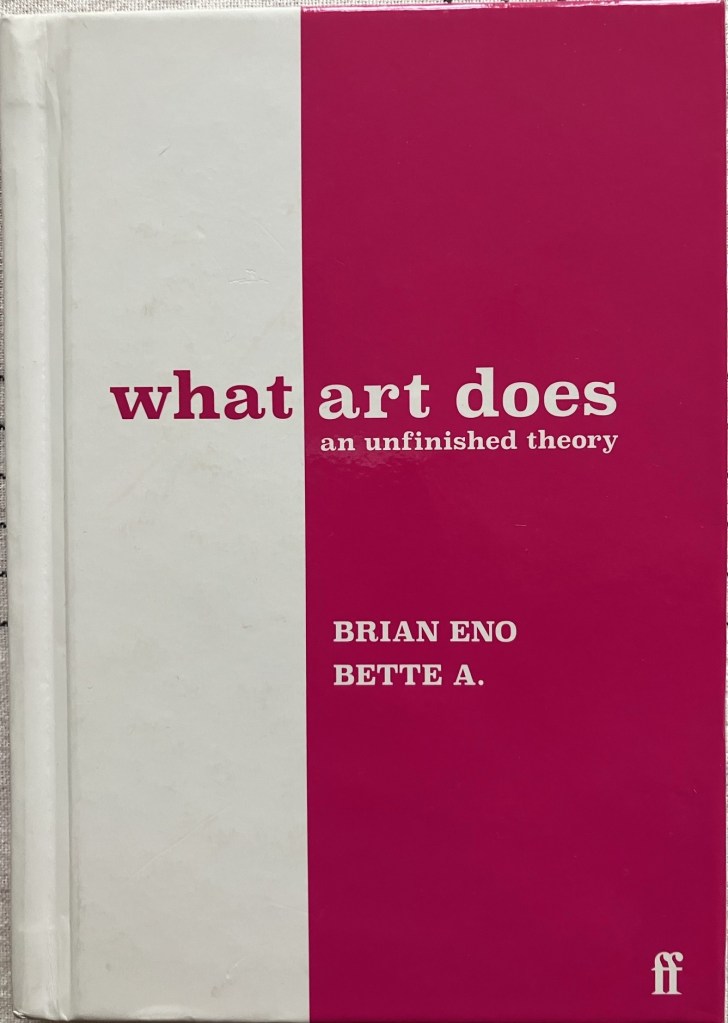
Browsing in a bookshop over the summer, my eyes were drawn to the bright pink cover of a small Faber book, what art does: an unfinished theory. It is a collaboration between electronic musician Brian Eno and artist Bette A. It has the form of a picture book—playful with fonts and layout, interspersed with sketches. It asks a simple and impossibly complex question: what does art do?
The authors are clear about what is at stake. “If we can’t answer that question,” they write, “then we shouldn’t be surprised when governments marginalize the arts and humanities in education, or when the ‘brighter’ students are directed away from the arts and humanities and into science and tech, or when support for theatres, libraries and concert halls is the first thing to be withdrawn in a financial squeeze.”
This warning comes a few pages in. I was hooked, and bought the book. I was drawn to its whimsical illustrations and its thought-provoking aphorisms:
PLAY IS HOW CHILDREN LEARN
ART IS HOW ADULTS PLAY
I bought the book for myself. But after I’d gulped it down in a single sitting, I realized that what I really wanted to do is to read it with my then 11-year-old son, who loves to draw and paint, and who used to pronounce the word imagine “imagic” ….
Over a week, I read it aloud to him at bedtime. It opened up many searching conversations. The idea he found hardest at first, but which he came to embrace, is that every piece of art is unfinished—that its meaning might shift when a viewer, or listener, responds to it. “Meanings are fluid, not eternal,” the book reminds us.
My son was intrigued by how Eno and Bette A. expanded his notion of what art is—to include hairstyles and gardens and myths and toys and saltshakers; to include “all kinds of things where somebody does more than is absolutely necessary for the sake of the feeling they get by doing it.” They use the memorable example of a screwdriver: its blade is purely functional, with its form is decreed by its function; but its handle can be shaped and decorated with infinite variations. My son had a look of wonder at this realization, as happens when we start to see the world differently.
We paused to consider a page made up entirely of a list of questions—questions we might ask ourselves when deciding why we like this pair of earrings more than that other one. We talked about the idea that art is safe: a way to explore complicated feelings, and to explore how far those feelings might stretch, without causing harm to ourselves or others.
If there is one question that I hope my son took away from discussing what art does, it is a simple one that the authors borrow from the musician Jon Hassell: What is it that I really like?
 Books for Our Children